
What Is Shockwave Therapy (and Why It’s a Go-To for Pain Relief and Doctor Referrals)
If you’ve been searching for answers to ongoing pain, like plantar fasciitis, shoulder pain, or tendonitis, you may have come across shockwave therapy. But what is it, and will it actually help?
Shockwave therapy might be something you come across or hear about after trying a few other things first, when an injury or ongoing pain just isn’t fully resolving.
While the name sounds a bit intense, shockwave is actually a non-invasive treatment that can deliver results fairly quickly.
It’s commonly used in sports and athletic settings and is often recommended by chiropractors, physios, and doctors because of how consistently it helps with stubborn, lingering injuries.
But it’s not just for athletes. We see the same types of overuse and chronic pain conditions in everyday life too, from desk workers and busy parents to labour-intensive jobs and weekend warriors.
Why some injuries don’t fully heal and why this is the perfect time to use Shockwave therapy:
One of the more frustrating things about pain, especially tendon or soft tissue pain, is that it doesn’t always follow a neat timeline.
We see this a lot with things like plantar fasciitis, frozen shoulder, or tennis/golfers elbow. What often happens is that the tissue doesn’t fully complete the healing process. Instead, it settles into a low-grade, irritated state where it’s not getting worse, but not getting better either.
Sometimes that’s because the area has limited blood flow or has started to calcify. Other times, it’s because the same movement or repetitive strain keeps re-irritating the tissue before it has a chance to fully heal.
So it stays stuck in that in-between phase, not acute, but not resolved either.
That’s when things start to plateau, and when we begin to think about introducing something different, like shockwave therapy.
So what is shockwave therapy?
Shockwave therapy uses acoustic (sound) waves to deliver mechanical energy into the tissue.
In simpler terms, it helps shock, or “wake up” an area that has stopped healing properly.
It works by:
increasing blood flow
reducing inflammation
producing more collagen
stimulating he body’s natural healing processes and cellular repair
facilitating the development of new blood vessels in the area
helping break down stubborn scar tissue or calcifications
It’s different from treatments like ultrasound or laser, which use heat or light. Shockwave creates a mechanical stimulus, which is often what these chronic, stubborn issues need.
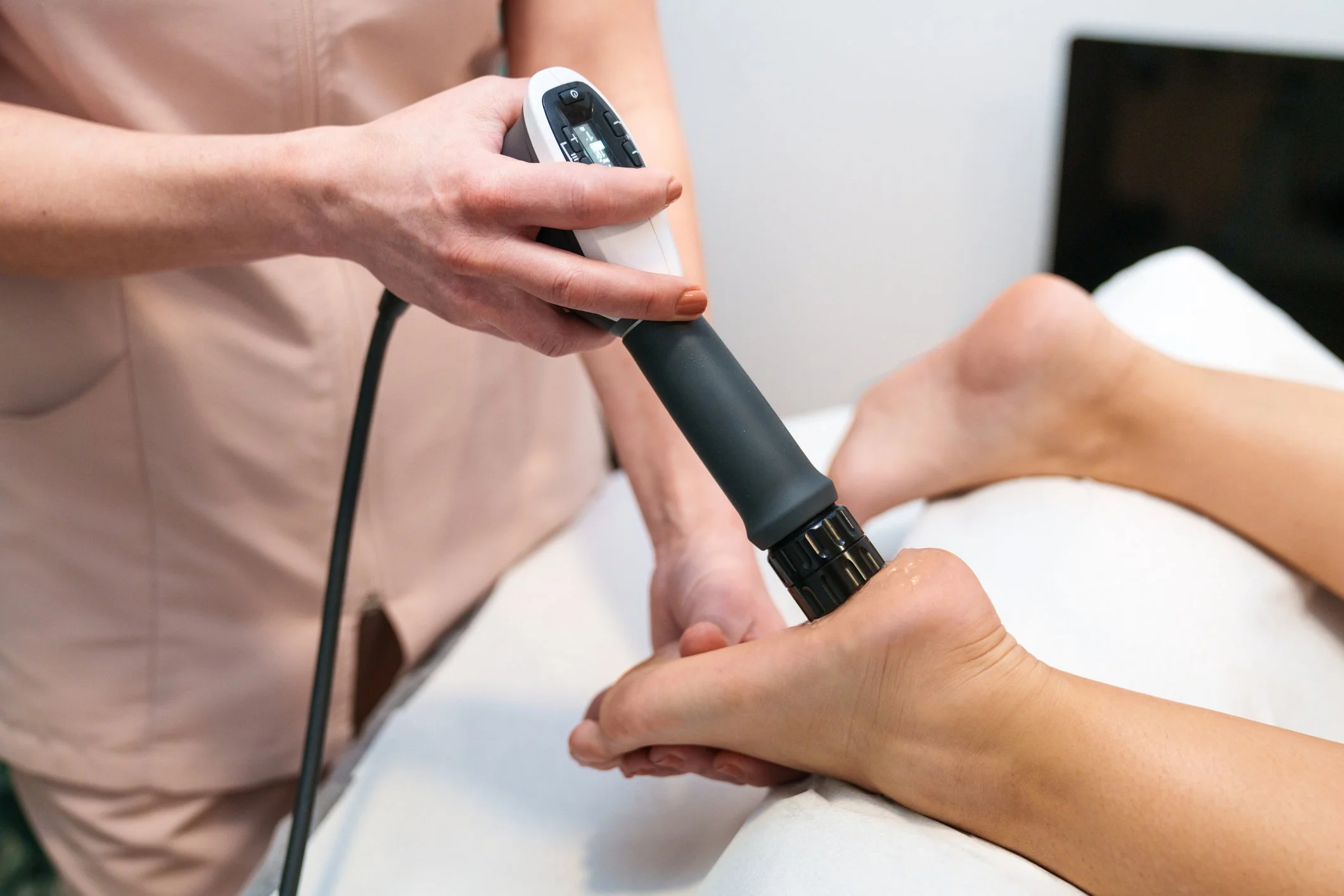
Shockwave therapy has been getting more attention lately,
especially for chronic pain and injuries that don’t fully respond to more traditional approaches.
A bit of a backstory (because it’s kind of interesting)
Shockwave therapy has been around for over 30 years, and like many things in medicine, it came from an unexpected place.
There’s a story often shared about early blast testing happening near populated areas. When researchers followed up with people living nearby, they found something surprising. Many reported less pain in chronic conditions like tendonitis and arthritis.
The theory was that these energy waves were interacting with the body at a cellular level and it helped spark the research that led to the treatment of breaking up kidney stones and eventually what we use today for more superficial musculoskeletal pain.
What type of things can it help with?
Shockwave therapy is most often used for injuries that have been hanging around for a while, especially when they haven’t responded to other treatments. Doctors are increasingly recommending shockwave as an alternative to more invasive options as it has been shown to accelerate healing and, in some cases, be as effective as corticosteroid injections or surgery.
The most common ones we see here at the clinic are:
plantar fasciitis (heel pain)
tennis elbow or golfer’s elbow
Achilles tendon issues
patellar tendon pain (jumper’s knee)
rotator cuff injuries
frozen shoulder
hamstring injuries
A few of the ways we’ve been pleasantly “shocked” by what shockwave can help with:
chronic hip or glute pain
persistent lower back tension
neck pain
stubborn trigger points or myofascial pain
pain related to osteoarthritis
It’s become one of those tools we are using more and more, both in how we treat patients and even how we take care of ourselves as practitioners.

A thoughtful, integrated approach to care
Shockwave therapy is offered by Dr. Karen Hudes as a natural extension of her chiropractic and rehabilitation work.
Did you know that Dr. Karen is a Fellow of the Canadian Chiropractic Specialty College of Physical and Occupational Rehabilitation (FCCPOR), with advanced training in exercise and rehabilitative therapy?
We love that about her as that background shapes how she uses shockwave, not just as a standalone treatment, but as part of a more comprehensive plan.
Shockwave is integrated with hands-on care, movement-based rehab, and a deeper understanding of how your body is functioning as a whole. The goal is not just short-term relief, but more lasting change.
When she was exploring different shockwave systems, Karen tested several options and ultimately chose the radial shockwave unit she now uses in clinic for its depth of penetration, versatility, and overall quality.
Karen’s experience (on both sides of the table):
What stood out most was Karen’s own experience.
After trying shockwave herself, she noticed a meaningful improvement in her plantar fasciitis after just one session, which helped confirm this was the right tool to bring into practice.
Since then, she’s continued to use it both clinically and personally.
She’s also currently using it to help manage osteoarthritis in her foot:
“While it doesn’t fix osteoarthritis, it has significantly reduced the pain. And when we combine that with hands-on care to improve mobility, it helps support longer-term change. Motion is lotion.”
That combination, reducing pain while improving how things move, is often where we see the biggest impact.
It’s also become a really valuable tool for our team.
As a manual therapy clinic, we’re all working with our hands throughout the day, whether that’s massage therapy, osteopathy, or chiropractic care. Over time, that can take a toll on our own bodies.
“Having shockwave available in the clinic has been a bit of a game changer, not just for patients but for our team as well. I’ll often have therapists pop in between appointments for a quick treatment, and even just a few minutes of focused shockwave can make a noticeable difference.”
What to expect from during your treatment:
Your first visit with Karen starts with a conversation.
She’ll take the time to understand what’s been going on, how long it’s been there, what you’ve tried so far, and what your goals are. From there, she’ll assess and begin treatment in the same visit.
Initial appointments are typically around 45 minutes, allowing time for intake, assessment, and hands-on care.
Follow-up sessions are shorter, usually 20- 30 minutes depending on your case, the areas being treated, and whether your visit includes just shockwave and rehab or also incorporates chiropractic care.
This is all mapped out during your first visit and guided by your treatment goals. Some people come for a more integrated approach using multiple tools, while others are specifically looking for focused shockwave treatment.
FAQs
-
This is usually the biggest question.
Most people come in expecting it to be painful and leave saying it was much more manageable than they thought.
The best way to describe it is like a light elastic band snapping on the skin. Some spots can feel a bit more sensitive, especially if the area is already sore, but treatments are quick, usually just a few minutes per area.
The intensity can be adjusted so it stays within a comfortable range. Karen typically keeps it around a 3/10, and if anything feels too much, it’s adjusted right away.
After treatment, it’s normal to feel a bit sore or sensitive for a day or two, similar to how your body might feel after a good workout. That’s part of the healing response.
-
The direct treatment is actually quite quick, often around 3 to 5 minutes per area.
-
Most people will need a short series of treatments, typically around 3-5 for less complex cases and to 5-8 sessions for more chronic or complex cases. Occasionally more sessions are indicated.
Appointments are usually spaced about a week apart, although in some cases they may be scheduled a bit closer together depending on what’s being treated.
Some people notice changes early on, even after the first couple of sessions. More often, the biggest improvements happen gradually over a few weeks as the tissue starts to repair itself more effectively.
The goal isn’t just short-term relief, but helping the body move out of that stuck phase and into a more complete healing process.
-
Shockwave therapy is often introduced when other treatments have helped but haven’t fully resolved the issue.
Not because those treatments were wrong, but because sometimes the body just needs a different kind of input to move things along.
Shockwave delivers targeted mechanical energy into the tissue, creating a small, controlled stimulus that helps restart the healing process. This can increase blood flow, stimulate repair, and help shift tissue out of that more chronic, irritated state.
It’s less about doing more, and more about doing something different, at the right time, for the right reason.
-
If you’ve been dealing with something that just isn’t improving, or keeps coming back, it might be worth exploring whether shockwave therapy could help.
At Continuum Wellness, care is always tailored to the individual. Shockwave therapy is one of the tools we use when it makes sense, integrated into a broader plan that supports how your body heals and moves over time.
If you’re curious, or wondering whether it might be a good fit for you, we’re always happy to talk it through.
-
Shockwave therapy is generally very safe, but like any treatment, it’s not the right fit for everyone.
It may not be recommended if you have certain conditions, including:
active infection in the area
open wounds or tumours
certain bone conditions or bone tumours
severe circulatory disorders
certain nerve disorders
if you are pregnant
if you are taking blood-thinning medication
This is always reviewed during your initial visit. Karen will go through your health history and make sure shockwave is a safe and appropriate option for you before starting treatment.
-
Shockwave therapy isn’t just about the device, it’s how it’s used.
At Continuum, it’s integrated into a broader approach that includes assessment, hands-on care, and movement-based rehab, all tailored to what your body actually needs.
Karen’s background in chiropractic and rehabilitative therapy allows her to look beyond where it hurts to understand why it’s happening and how to support longer-term change.